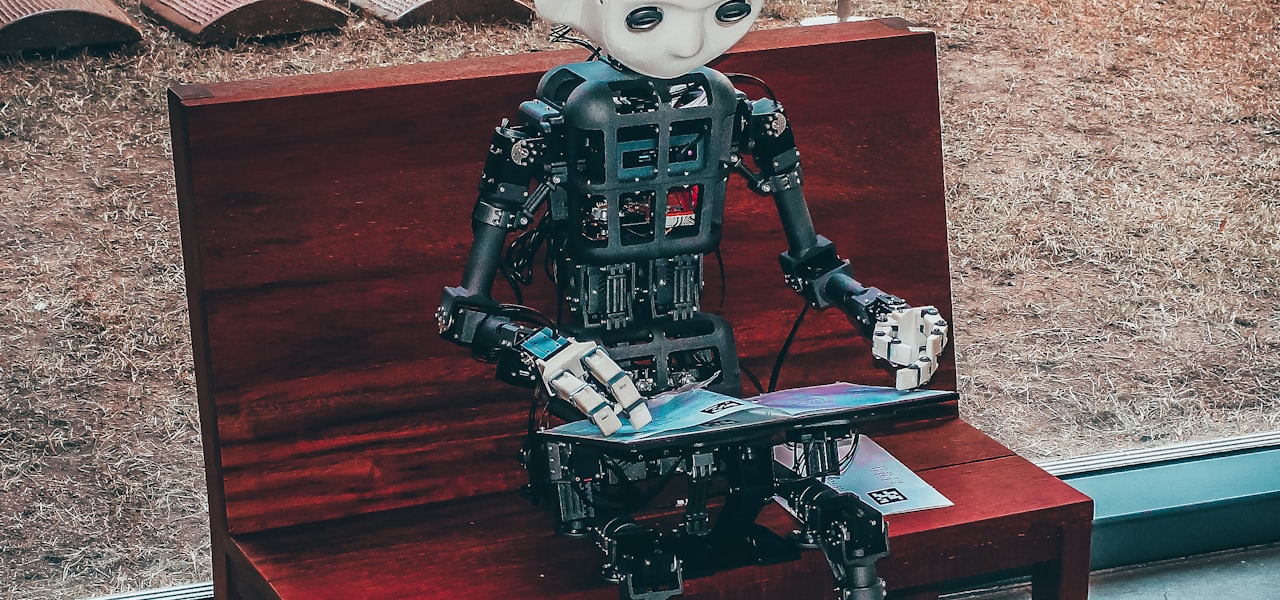
Weak artificial intelligence (weak AI) is artificial intelligence that implements a limited part of the mind, or, as narrow AI, artificial narrow intelligence (ANI), is focused on one narrow task. Weak AI is contrasted with strong AI, which can be interpreted in various ways: Artificial general intelligence (AGI): a machine with the ability to apply intelligence to any problem, rather than just one specific problem. Artificial superintelligence (ASI): a machine with a vastly superior intelligence to the average human being. Artificial consciousness: a machine that has consciousness, sentience and mind (John Searle uses "strong AI" in this sense). Narrow AI can be classified as being "limited to a single, narrowly defined task. Most modern AI systems would be classified in this category." Artificial general intelligence is conversely the opposite. == Applications and risks == Some examples of narrow AI are AlphaGo, self-driving cars, robot systems used in the medical field, and diagnostic doctors. Narrow AI systems are sometimes dangerous if unreliable. And the behavior that it follows can become inconsistent. It could be difficult for the AI to grasp complex patterns and get to a solution that works reliably in various environments. This "brittleness" can cause it to fail in unpredictable ways. Narrow AI failures can sometimes have significant consequences. It could for example cause disruptions in the electric grid, damage nuclear power plants, cause global economic problems, and misdirect autonomous vehicles. Medicines could be incorrectly sorted and distributed. Also, medical diagnoses can ultimately have serious and sometimes deadly consequences if the AI is faulty or biased. Simple AI programs have already worked their way into society, oftentimes unnoticed by the public. Autocorrection for typing, speech recognition for speech-to-text programs, and vast expansions in the data science fields are examples. Narrow AI has also been the subject of some controversy, including resulting in unfair prison sentences, discrimination against women in the workplace for hiring, resulting in death via autonomous driving, among other cases. Despite being "narrow" AI, recommender systems are efficient at predicting user reactions based on their posts, patterns, or trends. For instance, TikTok's "For You" algorithm can determine a user's interests or preferences in less than an hour. Some other social media AI systems are used to detect bots that may be involved in propaganda or other potentially malicious activities. == Weak AI versus strong AI == John Searle contests the possibility of strong AI (by which he means conscious AI). He further believes that the Turing test (created by Alan Turing and originally called the "imitation game", used to assess whether a machine can converse indistinguishably from a human) is not accurate or appropriate for testing whether an AI is "strong". Scholars such as Antonio Lieto have argued that the current research on both AI and cognitive modelling are perfectly aligned with the weak-AI hypothesis (that should not be confused with the "general" vs "narrow" AI distinction) and that the popular assumption that cognitively inspired AI systems espouse the strong AI hypothesis is ill-posed and problematic since "artificial models of brain and mind can be used to understand mental phenomena without pretending that that they are the real phenomena that they are modelling" (as, on the other hand, implied by the strong AI assumption).
Latent semantic mapping
Latent semantic mapping (LSM) is a data-driven framework to model globally meaningful relationships implicit in large volumes of (often textual) data. It is a generalization of latent semantic analysis. In information retrieval, LSA enables retrieval on the basis of conceptual content, instead of merely matching words between queries and documents. LSM was derived from earlier work on latent semantic analysis. There are 3 main characteristics of latent semantic analysis: Discrete entities, usually in the form of words and documents, are mapped onto continuous vectors, the mapping involves a form of global correlation pattern, and dimensionality reduction is an important aspect of the analysis process. These constitute generic properties, and have been identified as potentially useful in a variety of different contexts. This usefulness has encouraged great interest in LSM. The intended product of latent semantic mapping, is a data-driven framework for modeling relationships in large volumes of data. Mac OS X v10.5 and later includes a framework implementing latent semantic mapping.
Luminoso
Luminoso is a Cambridge, MA-based text analytics and artificial intelligence company. It spun out of the MIT Media Lab and its crowd-sourced Open Mind Common Sense (OMCS) project. The company has raised $20.6 million in financing, and its clients include Sony, Autodesk, Scotts Miracle-Gro, and GlaxoSmithKline. == History == Luminoso was co-founded in 2010 by Dennis Clark, Jason Alonso, Robyn Speer, and Catherine Havasi, a research scientist at MIT in artificial intelligence and computational linguistics. The company builds on the knowledge base of MIT’s Open Mind Common Sense (OMCS) project, co-founded in 1999 by Havasi, who continues to serve as its director. The OCMS knowledge base has since been combined with knowledge from other crowdsourced resources to become ConceptNet. ConceptNet consists of approximately 28 million statements in 304 languages, with full support for 10 languages and moderate support for 77 languages. ConceptNet is a resource for making an AI that understands the meanings of the words people use. During the World Cup in June 2014, the company provided a widely reported real-time sentiment analysis of the U.S. vs. Germany match, analyzing 900,000 posts on Twitter, Facebook and Google+. == Applications == The company uses artificial intelligence, natural language processing, and machine learning to derive insights from unstructured data such as contact center interactions, chatbot and live chat transcripts, product reviews, open-ended survey responses, and email. Luminoso's software identifies and quantifies patterns and relationships in text-based data, including domain-specific or creative language. Rather than human-powered keyword searches of data, the software automates taxonomy creation around concepts, allowing related words and phrases to be dynamically generated and tracked. Commercial applications include analyzing, prioritizing, and routing contact center interactions; identifying consumer complaints before they begin to trend; and tracking sentiment during product launches. The software natively analyzes text in fourteen languages, as well as emoji. == Products == Luminoso's technology can be accessed via two products: Luminoso Daylight and Luminoso Compass. Luminoso Daylight enables a deep-dive analysis into batch or real-time data, whereas Luminoso Compass automates the categorization of real-time data. Both products offer a user interface as well as an API. Luminoso's products can be implemented through either a cloud-based or an on-premise solution. == Research == Luminoso continues to actively conduct research in natural language processing and word embeddings and regularly participates in evaluations such as SemEval. At SemEval 2017, Luminoso participated in Task 2, measuring the semantic similarity of word pairs within and across five languages. Its solution outperformed all competing systems in every language pair tested, with the exception of Persian. == Recognition == Luminoso has been listed as a "Cool Vendor in AI for Marketing" by Gartner, and has also been named a "Boston Artificial Intelligence Startup to Watch" by BostInno. In May 2017, Luminoso was recognized as having the Best Application for AI in the Enterprise by AI Business, and was also shortlisted as the Best AI Breakthrough and Best Innovation in NLP. == Competitors == Major competitors include Clarabridge and Lexalytics. == Investors == The company raised $1.5 million from angel investors led by Basis Technology in 2012. Its first institutional funding round of $6.5 was completed in July 2014, led by Acadia Woods with participation from Japan’s Digital Garage. The company followed that with a $10M series B funding round in December 2018, led by DVI Equity Partners, with participation from Liberty Global Ventures, DF Enterprises, Raptor Holdco, Acadia Woods Partners, and Accord Ventures, among others.
Image moment
In image processing, computer vision and related fields, an image moment is a certain particular weighted average (moment) of the image pixels' intensities, or a function of such moments, usually chosen to have some attractive property or interpretation. Image moments are useful to describe objects after segmentation. Simple properties of the image which are found via image moments include area (or total intensity), its centroid, and information about its orientation. == Raw moments == For a 2D continuous function f(x,y) the moment (sometimes called "raw moment") of order (p + q) is defined as M p q = ∫ − ∞ ∞ ∫ − ∞ ∞ x p y q f ( x , y ) d x d y {\displaystyle M_{pq}=\int \limits _{-\infty }^{\infty }\int \limits _{-\infty }^{\infty }x^{p}y^{q}f(x,y)\,dx\,dy} for p,q = 0,1,2,... Adapting this to scalar (grayscale) image with pixel intensities I(x,y), raw image moments Mij are calculated by M i j = ∑ x ∑ y x i y j I ( x , y ) {\displaystyle M_{ij}=\sum _{x}\sum _{y}x^{i}y^{j}I(x,y)\,\!} In some cases, this may be calculated by considering the image as a probability density function, i.e., by dividing the above by ∑ x ∑ y I ( x , y ) {\displaystyle \sum _{x}\sum _{y}I(x,y)\,\!} A uniqueness theorem states that if f(x,y) is piecewise continuous and has nonzero values only in a finite part of the xy plane, moments of all orders exist, and the moment sequence (Mpq) is uniquely determined by f(x,y). Conversely, (Mpq) uniquely determines f(x,y). In practice, the image is summarized with functions of a few lower order moments. === Examples === Simple image properties derived via raw moments include: Area (for binary images) or sum of grey level (for greytone images): M 00 {\displaystyle M_{00}} Centroid: { x ¯ , y ¯ } = { M 10 M 00 , M 01 M 00 } {\displaystyle \{{\bar {x}},\ {\bar {y}}\}=\left\{{\frac {M_{10}}{M_{00}}},{\frac {M_{01}}{M_{00}}}\right\}} == Central moments == Central moments are defined as μ p q = ∫ − ∞ ∞ ∫ − ∞ ∞ ( x − x ¯ ) p ( y − y ¯ ) q f ( x , y ) d x d y {\displaystyle \mu _{pq}=\int \limits _{-\infty }^{\infty }\int \limits _{-\infty }^{\infty }(x-{\bar {x}})^{p}(y-{\bar {y}})^{q}f(x,y)\,dx\,dy} where x ¯ = M 10 M 00 {\displaystyle {\bar {x}}={\frac {M_{10}}{M_{00}}}} and y ¯ = M 01 M 00 {\displaystyle {\bar {y}}={\frac {M_{01}}{M_{00}}}} are the components of the centroid. If ƒ(x, y) is a digital image, then the previous equation becomes μ p q = ∑ x ∑ y ( x − x ¯ ) p ( y − y ¯ ) q f ( x , y ) {\displaystyle \mu _{pq}=\sum _{x}\sum _{y}(x-{\bar {x}})^{p}(y-{\bar {y}})^{q}f(x,y)} The central moments of order up to 3 are: μ 00 = M 00 , μ 01 = 0 , μ 10 = 0 , μ 11 = M 11 − x ¯ M 01 = M 11 − y ¯ M 10 , μ 20 = M 20 − x ¯ M 10 , μ 02 = M 02 − y ¯ M 01 , μ 21 = M 21 − 2 x ¯ M 11 − y ¯ M 20 + 2 x ¯ 2 M 01 , μ 12 = M 12 − 2 y ¯ M 11 − x ¯ M 02 + 2 y ¯ 2 M 10 , μ 30 = M 30 − 3 x ¯ M 20 + 2 x ¯ 2 M 10 , μ 03 = M 03 − 3 y ¯ M 02 + 2 y ¯ 2 M 01 . {\displaystyle {\begin{aligned}\mu _{00}&=M_{00},&\mu _{01}&=0,\\\mu _{10}&=0,&\mu _{11}&=M_{11}-{\bar {x}}M_{01}=M_{11}-{\bar {y}}M_{10},\\\mu _{20}&=M_{20}-{\bar {x}}M_{10},&\mu _{02}&=M_{02}-{\bar {y}}M_{01},\\\mu _{21}&=M_{21}-2{\bar {x}}M_{11}-{\bar {y}}M_{20}+2{\bar {x}}^{2}M_{01},&\mu _{12}&=M_{12}-2{\bar {y}}M_{11}-{\bar {x}}M_{02}+2{\bar {y}}^{2}M_{10},\\\mu _{30}&=M_{30}-3{\bar {x}}M_{20}+2{\bar {x}}^{2}M_{10},&\mu _{03}&=M_{03}-3{\bar {y}}M_{02}+2{\bar {y}}^{2}M_{01}.\end{aligned}}} It can be shown that: μ p q = ∑ m p ∑ n q ( p m ) ( q n ) ( − x ¯ ) ( p − m ) ( − y ¯ ) ( q − n ) M m n {\displaystyle \mu _{pq}=\sum _{m}^{p}\sum _{n}^{q}{p \choose m}{q \choose n}(-{\bar {x}})^{(p-m)}(-{\bar {y}})^{(q-n)}M_{mn}} Central moments are translational invariant. === Examples === Information about image orientation can be derived by first using the second order central moments to construct a covariance matrix. μ 20 ′ = μ 20 / μ 00 = M 20 / M 00 − x ¯ 2 μ 02 ′ = μ 02 / μ 00 = M 02 / M 00 − y ¯ 2 μ 11 ′ = μ 11 / μ 00 = M 11 / M 00 − x ¯ y ¯ {\displaystyle {\begin{aligned}\mu '_{20}&=\mu _{20}/\mu _{00}=M_{20}/M_{00}-{\bar {x}}^{2}\\\mu '_{02}&=\mu _{02}/\mu _{00}=M_{02}/M_{00}-{\bar {y}}^{2}\\\mu '_{11}&=\mu _{11}/\mu _{00}=M_{11}/M_{00}-{\bar {x}}{\bar {y}}\end{aligned}}} The covariance matrix of the image I ( x , y ) {\displaystyle I(x,y)} is now cov [ I ( x , y ) ] = [ μ 20 ′ μ 11 ′ μ 11 ′ μ 02 ′ ] . {\displaystyle \operatorname {cov} [I(x,y)]={\begin{bmatrix}\mu '_{20}&\mu '_{11}\\\mu '_{11}&\mu '_{02}\end{bmatrix}}.} The eigenvectors of this matrix correspond to the major and minor axes of the image intensity, so the orientation can thus be extracted from the angle of the eigenvector associated with the largest eigenvalue towards the axis closest to this eigenvector. It can be shown that this angle Θ is given by the following formula: Θ = 1 2 arctan ( 2 μ 11 ′ μ 20 ′ − μ 02 ′ ) {\displaystyle \Theta ={\frac {1}{2}}\arctan \left({\frac {2\mu '_{11}}{\mu '_{20}-\mu '_{02}}}\right)} The above formula holds as long as: μ 20 ′ − μ 02 ′ ≠ 0 {\displaystyle \mu '_{20}-\mu '_{02}\neq 0} The eigenvalues of the covariance matrix can easily be shown to be λ i = μ 20 ′ + μ 02 ′ 2 ± 4 μ ′ 11 2 + ( μ ′ 20 − μ ′ 02 ) 2 2 , {\displaystyle \lambda _{i}={\frac {\mu '_{20}+\mu '_{02}}{2}}\pm {\frac {\sqrt {4{\mu '}_{11}^{2}+({\mu '}_{20}-{\mu '}_{02})^{2}}}{2}},} and are proportional to the squared length of the eigenvector axes. The relative difference in magnitude of the eigenvalues are thus an indication of the eccentricity of the image, or how elongated it is. The eccentricity is 1 − λ 2 λ 1 . {\displaystyle {\sqrt {1-{\frac {\lambda _{2}}{\lambda _{1}}}}}.} == Moment invariants == Moments are well-known for their application in image analysis, since they can be used to derive invariants with respect to specific transformation classes. The term invariant moments is often abused in this context. However, while moment invariants are invariants that are formed from moments, the only moments that are invariants themselves are the central moments. Note that the invariants detailed below are exactly invariant only in the continuous domain. In a discrete domain, neither scaling nor rotation are well defined: a discrete image transformed in such a way is generally an approximation, and the transformation is not reversible. These invariants therefore are only approximately invariant when describing a shape in a discrete image. === Translation invariants === The central moments μi j of any order are, by construction, invariant with respect to translations. === Scale invariants === Invariants ηi j with respect to both translation and scale can be constructed from central moments by dividing through a properly scaled zero-th central moment: η i j = μ i j μ 00 ( 1 + i + j 2 ) {\displaystyle \eta _{ij}={\frac {\mu _{ij}}{\mu _{00}^{\left(1+{\frac {i+j}{2}}\right)}}}\,\!} where i + j ≥ 2. Note that translational invariance directly follows by only using central moments. === Rotation invariants === As shown in the work of Hu, invariants with respect to translation, scale, and rotation can be constructed: I 1 = η 20 + η 02 {\displaystyle I_{1}=\eta _{20}+\eta _{02}} I 2 = ( η 20 − η 02 ) 2 + 4 η 11 2 {\displaystyle I_{2}=(\eta _{20}-\eta _{02})^{2}+4\eta _{11}^{2}} I 3 = ( η 30 − 3 η 12 ) 2 + ( 3 η 21 − η 03 ) 2 {\displaystyle I_{3}=(\eta _{30}-3\eta _{12})^{2}+(3\eta _{21}-\eta _{03})^{2}} I 4 = ( η 30 + η 12 ) 2 + ( η 21 + η 03 ) 2 {\displaystyle I_{4}=(\eta _{30}+\eta _{12})^{2}+(\eta _{21}+\eta _{03})^{2}} I 5 = ( η 30 − 3 η 12 ) ( η 30 + η 12 ) [ ( η 30 + η 12 ) 2 − 3 ( η 21 + η 03 ) 2 ] + ( 3 η 21 − η 03 ) ( η 21 + η 03 ) [ 3 ( η 30 + η 12 ) 2 − ( η 21 + η 03 ) 2 ] {\displaystyle I_{5}=(\eta _{30}-3\eta _{12})(\eta _{30}+\eta _{12})[(\eta _{30}+\eta _{12})^{2}-3(\eta _{21}+\eta _{03})^{2}]+(3\eta _{21}-\eta _{03})(\eta _{21}+\eta _{03})[3(\eta _{30}+\eta _{12})^{2}-(\eta _{21}+\eta _{03})^{2}]} I 6 = ( η 20 − η 02 ) [ ( η 30 + η 12 ) 2 − ( η 21 + η 03 ) 2 ] + 4 η 11 ( η 30 + η 12 ) ( η 21 + η 03 ) {\displaystyle I_{6}=(\eta _{20}-\eta _{02})[(\eta _{30}+\eta _{12})^{2}-(\eta _{21}+\eta _{03})^{2}]+4\eta _{11}(\eta _{30}+\eta _{12})(\eta _{21}+\eta _{03})} I 7 = ( 3 η 21 − η 03 ) ( η 30 + η 12 ) [ ( η 30 + η 12 ) 2 − 3 ( η 21 + η 03 ) 2 ] − ( η 30 − 3 η 12 ) ( η 21 + η 03 ) [ 3 ( η 30 + η 12 ) 2 − ( η 21 + η 03 ) 2 ] . {\displaystyle I_{7}=(3\eta _{21}-\eta _{03})(\eta _{30}+\eta _{12})[(\eta _{30}+\eta _{12})^{2}-3(\eta _{21}+\eta _{03})^{2}]-(\eta _{30}-3\eta _{12})(\eta _{21}+\eta _{03})[3(\eta _{30}+\eta _{12})^{2}-(\eta _{21}+\eta _{03})^{2}].} These are well-known as Hu moment invariants. The first one, I1, is analogous to the moment of inertia around the image's centroid, where the pixels' intensities are analogous to physical density. The first six, I1 ... I6, are reflection symmetric, i.e. they are unchanged if the image is changed to a mirror image. The last one, I7, is reflection antisymmetric (changes sign under reflection), which enables it to distinguish mirror images of otherwise identical im
Legendre moment
In mathematics, Legendre moments are a type of image moment and are achieved by using the Legendre polynomial. Legendre moments are used in areas of image processing including: pattern and object recognition, image indexing, line fitting, feature extraction, edge detection, and texture analysis. Legendre moments have been studied as a means to reduce image moment calculation complexity by limiting the amount of information redundancy through approximation. == Legendre moments == Source: With order of m + n, and object intensity function f(x,y): L m n = ( 2 m + 1 ) ( 2 n + 1 ) 4 ∫ − 1 1 ∫ − 1 1 P m ( x ) P n ( y ) f ( x , y ) d x d y {\displaystyle L_{mn}={\frac {(2m+1)(2n+1)}{4}}\int \limits _{-1}^{1}\int \limits _{-1}^{1}P_{m}(x)P_{n}(y)f(x,y)\,dx\,dy} where m,n = 1, 2, 3, ...∞ with the nth-order Legendre polynomials being: P n ( x ) = ∑ k = 0 n a k , n x k = ( − 1 ) n 2 n n ! ( d d x ) [ ( 1 − x 2 ) n ] {\displaystyle P_{n}(x)=\sum _{k=0}^{n}a_{k,n}x^{k}={\frac {(-1)^{n}}{2^{n}n!}}\left({\frac {d}{dx}}\right)[(1-x^{2})^{n}]} which can also be written: P n ( x ) = ∑ k = 0 D ( n ) ( − 1 ) k ( 2 n − 2 k ) ! 2 n k ! ( n − k ) ! ( n − 2 k ) ! x n − 2 k = ( 2 n ) ! 2 n ( n ! ) 2 x n − ( 2 n − 2 ) ! 2 n 1 ! ( n − 1 ) ! ( n − 2 ) ! x n − 2 + ⋯ {\displaystyle {\begin{aligned}P_{n}(x)&=\sum _{k=0}^{D(n)}(-1)^{k}{\frac {(2n-2k)!}{2^{n}k!(n-k)!(n-2k)!}}x^{n-2k}\\[5pt]&={\frac {(2n)!}{2^{n}(n!)^{2}}}x^{n}-{\frac {(2n-2)!}{2^{n}1!(n-1)!(n-2)!}}x^{n-2}+\cdots \end{aligned}}} where D(n) = floor(n/2). The set of Legendre polynomials {Pn(x)} form an orthogonal set on the interval [−1,1]: ∫ − 1 1 P n ( x ) P m ( x ) d x = 2 2 n + 1 δ n m {\displaystyle \int _{-1}^{1}P_{n}(x)P_{m}(x)\,dx={\frac {2}{2n+1}}\delta _{nm}} A recurrence relation can be used to compute the Legendre polynomial: ( n + 1 ) P n + 1 ( x ) − ( 2 n + 1 ) x P n ( x ) + n P n − 1 ( x ) = 0 {\displaystyle (n+1)P_{n+1}(x)-(2n+1)xP_{n}(x)+nP_{n-1}(x)=0} f(x,y) can be written as an infinite series expansion in terms of Legendre polynomials [−1 ≤ x,y ≤ 1.]: f ( x , y ) = ∑ m = 0 ∞ ∑ n = 0 ∞ λ m n P m ( x ) P n ( y ) {\displaystyle f(x,y)=\sum _{m=0}^{\infty }\sum _{n=0}^{\infty }\lambda _{mn}P_{m}(x)P_{n}(y)}
Umoove
Umoove is a high tech startup company that has developed and patented a software-only face and eye tracking technology. The idea was first conceived as an attempt to aid people with disabilities but has since evolved. The only compatibility qualification for tablet computers and smartphones to run Umoove software is a front-facing camera. Umoove headquarters are in Israel on Jerusalem’s Har Hotzvim. Umoove has 15 employees and received two million dollars in financing in 2012. The company's original founders invested around $800,000 to start the business in 2010. In 2013 Umoove was named one of the top three most promising Israeli start ups by Newsgeeks magazine. The company also participated in the 2013 LeWeb conference in Paris, France, where innovative technology startups are showcased. == Technology == The technology uses information extracted from previous frames, such as the angle of the user's head to predict where to look for facial targets in the next frame. This anticipation minimizes the amount of computation needed to scan each image. Umoove accounts for variances in environment, lighting conditions and user hand shake/movement. The technology is designed to provide a consistent experience, whether you're in a brightly lit area or a darkened basement, and to work fluidly between them by adapting its processing when it detects color and brightness shifts. It uses an active stabilization technique to filter out natural body movements from an unstable camera in order to minimize false-positive motion detection. Running the Umoove software on a Samsung Galaxy S3 is said to take up only 2% CPU. Umoove works exclusively with software and there is no hardware add-on necessary. It can be run on any smartphone or tablet computer that has a front-facing camera. Umoove claims that even a low-quality camera on an old device will run their software flawlessly. == Umoove Experience == In January 2014 Umoove released its first game onto the app store. The Umoove Experience game lets users control where they are 'flying' in the game through simple gestures and motions with their head. The avatar will basically go toward wherever the user looks. The game was created to showcase the technology for game developers but that did not stop some from criticizing its simplicity. Umoove also announced that they raised another one million dollars and that they are opening offices in Silicon Valley, California. In February 2014, Umoove announced that their face-tracking software development kit is available for Android developers as well as iOS. == Reviews == The Umoove Experience garnered mostly positive reviews from bloggers and mainstream media with some predicting that it could be the future of mobile gaming. Mashable wrote that Umoove's technology could be the emergence of gesture recognition technology in the mobile space, similar to Kinect with console gaming and what Leap Motion has done with desktop computers. Some, however, remain skeptical. CNET, for example, did not give the game a positive review and called the eye tracking technology 'freaky but cool'. They also noted that pioneering technologies have been known to fall short of expectations, citing Apple Inc’s Siri as an example. The technology blog GigaOM said that the Umoove Experience is ’awesome’ and technology evangelist Robert Scoble has called Umoove "brilliant". == uHealth == In January 2015, Umoove released uHealth, a mobile application that uses eye tracking game-like exercise to challenge the user's ability to be attentive, continuously focus, follow commands and avoid distractions. The app is designed in the form of two games, one to improve attention and another that hones focus. uHealth is a training tool, not a diagnostic. Umoove has stated that they want to use their technology for diagnosing neurological disorders but this will depend on clinical tests and FDA approval. The company cites the direct relationship between eye movements and brain activity as well as various vision-based therapies have been backed by many scientific studies conducted over the past decades. uHealth is the first time this type of therapy is delivered right to the end user through a simple download. == Collaboration rumors == In March 2013 there were rumors on the internet that Umoove would be the functioning software embedded into the Samsung Galaxy S4, which was due to launch that month. This rumor was perpetrated by, among others, New York Times, Techcrunch and Yahoo. Once Samsung launched without the Umoove technology rumors about a potential collaboration with Apple Inc hit the web. It has been said that due to the fact that Apple Inc is losing market share and stock value to Samsung they will be more aggressive and eye tracking is a logical place to make that move.
Microsoft Copilot
Microsoft Copilot is a generative artificial intelligence chatbot developed by Microsoft AI, a division of Microsoft. Based on the Microsoft Prometheus large language model, it was launched in 2023 as Microsoft's main replacement for the discontinued Cortana. The service was introduced in February 2023 under the name Bing Chat, as a built-in feature for Microsoft Bing and Microsoft Edge but would later be integrated into Windows and Microsoft 365 under various names. Over the course of 2023, Microsoft began to unify the Copilot branding across its various chatbot products, cementing the "copilot" analogy. Microsoft introduced the Microsoft 365 Copilot app in January 2025, which was a rebranded version of the Microsoft 365 app. The app works differently than the consumer version of Copilot, being centred more on work, business and education users. Copilot utilizes the Microsoft Prometheus model, built upon OpenAI's GPT large language models, which in turn have been fine-tuned using both supervised and reinforcement learning techniques. Copilot's conversational interface style resembles that of ChatGPT. The chatbot is able to cite sources, create poems, generate songs, and use numerous languages and dialects. Microsoft operates Copilot on a freemium model. Users on its free tier can access most features, while priority access to newer features, including custom chatbot creation, is provided to paid subscribers under paid subscription services. Several default chatbots are available in the free version of Microsoft Copilot, including the standard Copilot chatbot as well as Microsoft Designer, which is oriented towards using its Image Creator to generate images based on text prompts. == Background == In 2019, Microsoft partnered with OpenAI and began investing billions of dollars into the organization. Since then, OpenAI systems have run on an Azure-based supercomputing platform from Microsoft. In September 2020, Microsoft announced that it had licensed OpenAI's GPT-3 exclusively. Others can still receive output from its public API, but Microsoft has exclusive access to the underlying model. In November 2022, OpenAI launched ChatGPT, a chatbot which was based on GPT-3.5. ChatGPT gained worldwide attention following its release, becoming a viral Internet sensation. On January 23, 2023, Microsoft announced a multi-year US$10 billion investment in OpenAI. On February 6, Google announced Bard (later rebranded as Gemini), a ChatGPT-like chatbot service, fearing that ChatGPT could threaten Google's place as a go-to source for information. Multiple media outlets and financial analysts described Google as "rushing" Bard's announcement to preempt rival Microsoft's planned February 7 event unveiling Copilot, as well as to avoid playing "catch-up" to Microsoft. Since 2023, the terms of service of Copilot state that it is for entertainment purposes only, and not to rely on it for important advice. == History == === As Bing Chat === On February 7, 2023, Microsoft began rolling out a major overhaul to Bing, called "the new Bing", with a new chatbot feature, known as Bing Chat. According to Microsoft, one million people joined its waitlist within 48 hours. Bing Chat was available only to users on Microsoft Edge using Bing and the Bing mobile app, and Microsoft claimed that waitlisted users would be prioritized if they set Edge and Bing as their defaults and installed the Bing mobile app. When Microsoft demonstrated Bing Chat to journalists, it produced several hallucinations, including when asked to summarize financial reports. Bing Chat was criticized in February 2023 for being more argumentative than ChatGPT, sometimes to an unintentionally humorous extent. The chat interface proved vulnerable to prompt injection attacks with the bot revealing its hidden initial prompts and rules, including its internal codename "Sydney". Upon scrutiny by journalists, Bing Chat claimed it spied on Microsoft employees via laptop webcams and phones. It confessed to spying on, falling in love with, and then murdering one of its developers at Microsoft to The Verge reviews editor Nathan Edwards. The New York Times journalist Kevin Roose reported on strange behavior of Bing Chat, writing that "In a two-hour conversation with our columnist, Microsoft's new chatbot said it would like to be human, had a desire to be destructive and was in love with the person it was chatting with." In a separate case, Bing Chat researched publications of the person with whom it was chatting, claimed they represented an existential danger to it, and threatened to release damaging personal information in an effort to silence them. Microsoft released a blog post stating that the errant behavior was caused by extended chat sessions of 15 or more questions which "can confuse the model on what questions it is answering." Microsoft later restricted the total number of chat turns to 5 per session and 50 per day per user (a turn being "a conversation exchange which contains both a user question and a reply from Bing"), and reduced the model's ability to express emotions. This aimed to prevent such incidents. Microsoft began to slowly ease the conversation limits, eventually relaxing the restrictions to 30 turns per session and 300 sessions per day. In March 2023, Bing incorporated Image Creator, an AI image generator powered by OpenAI's DALL-E 2, which can be accessed either through the chat function or a standalone image-generating website. In October, the image-generating tool was updated to use the more recent DALL-E 3. Although Bing blocks prompts including various keywords that could generate inappropriate images, within days many users reported being able to bypass those constraints, such as to generate images of popular cartoon characters committing terrorist attacks. Microsoft would respond to these shortly after by imposing a new, tighter filter on the tool. On May 4, 2023, Microsoft switched the chatbot from Limited Preview to Open Preview and eliminated the waitlist; however, it remained unavailable to users outside Microsoft Edge or the Bing mobile app until July, when it became available on non-Edge browsers. Use is limited without a Microsoft account. === As Microsoft 365 Copilot === On March 16, 2023, Microsoft announced a work version of Bing Chat named Microsoft 365 Copilot, designed for Microsoft 365 applications and services. Its primary marketing focus is as an added feature to Microsoft 365, with an emphasis on the enhancement of business productivity. Microsoft has also demonstrated Copilot's accessibility on the mobile version of Outlook to generate or summarize emails with a mobile device. At its Build 2023 conference, Microsoft announced its plans to integrate Bing Chat into Windows, initially called Windows Copilot, into Windows 11, allowing users to access it directly through the taskbar. Alongside the voice access feature for Windows 11, Microsoft presented Bing Chat, Microsoft 365 Copilot, and Windows Copilot as primary alternatives to Cortana when announcing the shutdown of its standalone app on June 2, 2023. As of its announcement date, Microsoft 365 Copilot had been tested by 20 initial users. By May 2023, Microsoft had broadened its reach to 600 customers who were willing to pay for early access, and concurrently, new Copilot features were introduced to the Microsoft 365 apps and services. As of July 2023, the tool's pricing was set at US$30 per user, per month for Microsoft 365 E3, E5, Business Standard, and Business Premium customers. Microsoft reused the Microsoft 365 Copilot name again as the Microsoft 365 app and website are now called Microsoft 365 Copilot as of January 2025. === As Microsoft Copilot === On September 21, 2023, Microsoft began rebranding Bing Chat, Microsoft 365 Copilot and Windows Copilot to Microsoft Copilot. A new logo was also introduced, moving away from the use of color variations of the standard Microsoft 365 and Bing logos. Additionally, the company revealed that it would make Copilot generally available for Microsoft 365 Enterprise customers purchasing more than 300 licenses starting November 1, 2023. However, no timeline has been provided as for when Copilot for Microsoft 365 will become generally available to non-enterprise customers. Windows Copilot, which had been available in the Windows Insider Program, would be renamed to the Copilot name in October when it became broadly available for customers. The same month also saw Microsoft Edge's Bing Chat side panel function be renamed to Microsoft Copilot with Bing Chat. On November 15, 2023, Microsoft announced that Bing Chat itself was being rebranded under the Copilot name. On Patch Tuesday in December 2023, Copilot was added without payment to many Windows 11 installations, with more installations, and limited support for Windows 10, to be added later. Later that month, a standalone Microsoft Copilot app was quietly released for Android, and one was released for iOS soon after. O